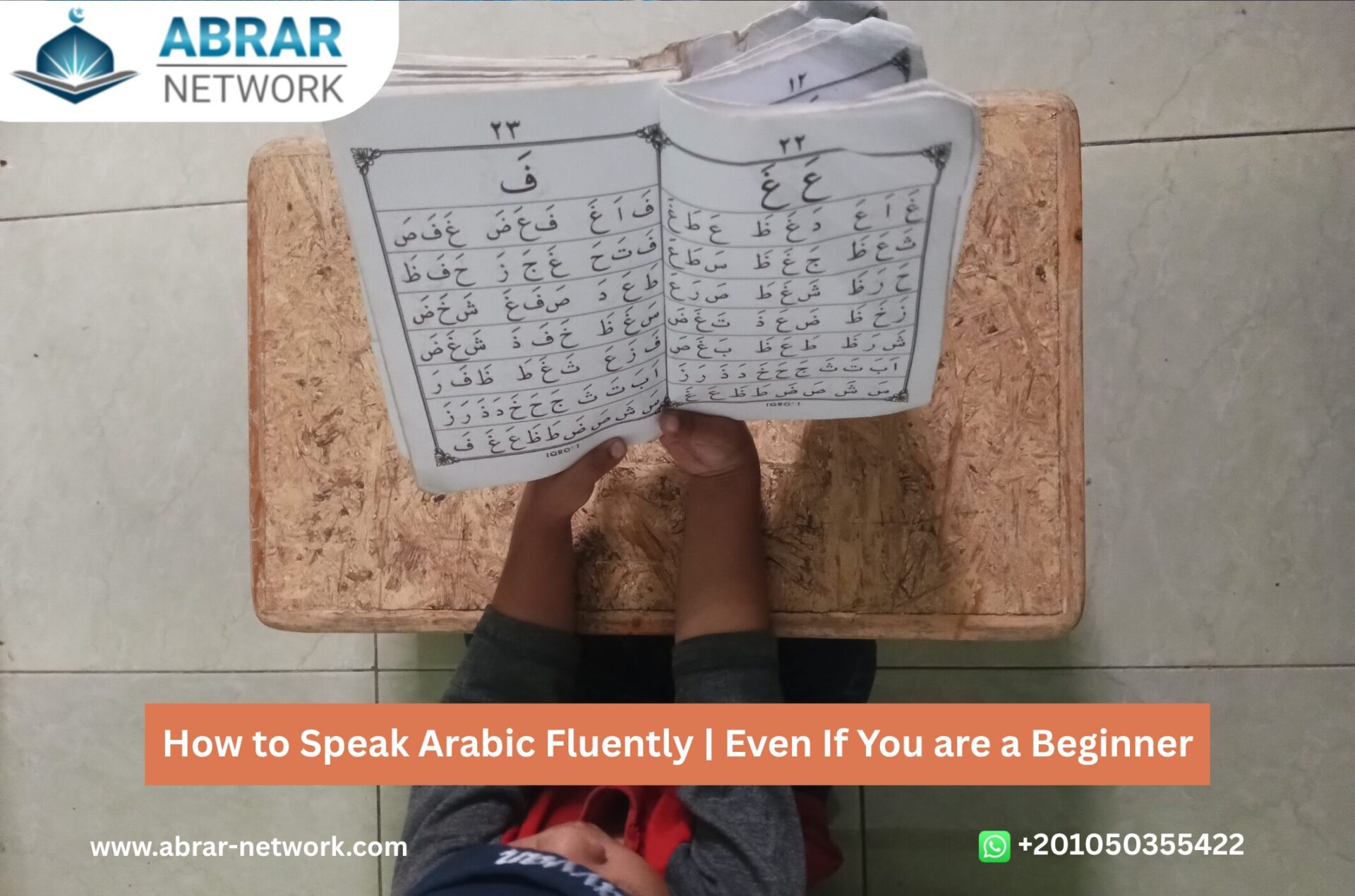
If you truly want to speak Arabic fluently, dedicate yourself to modern learning methods for less than a year. With consistency, genuine passion, and a real love for learning, you’ll be able to speak Arabic with confidence and fluency.
Defining the concept of learning to speak Arabic?
Learning to speak Arabic fluently involves learning how to pronounce the letters, sounds, and different articulation points that enable a person to pronounce words correctly. Muslims desire this so that they can read the Quran correctly and understand its meanings.
How can I speak Arabic fluently?
To speak Arabic fluently, you need to develop the following skills:
Listening:
Listening is one of the strongest ways to learn. When you listen to a language for a long time, you can build a large and varied vocabulary.
Reading:
Reading books in your areas of interest in Arabic helps you learn faster. So, keep a daily habit of reading in Arabic.
Writing:
Practice writing in Arabic by commenting on social media or messaging your Arab friends.
Speaking:
The more you speak, the less fear you will have. You will be able to speak Arabic without feeling shy about making mistakes.
Immerse yourself in the language:
Meet Arabs around you or people learning Arabic. Talk to them, watch how they pronounce letters, and listen to their daily conversations.
How long does it take to become fluent?
To seriously learn Arabic, it usually takes 6 months to 1 year if you study and practice 4 to 5 hours every day, including reading and active use.
If you only spend one hour a day learning a skill, it may take more than a year to become fluent.
Using multimedia tools and apps can help save time by providing engaging and interactive exercises, making learning more effective and efficient.
How do I know that I’ve reached fluency in Arabic?
When you can make sentences in a conversation without mistakes.
When you understand about 80% of what your Arab friends say, or when you listen to an Arabic podcast.
When you can speak confidently and skillfully.
When you can move around an Arabic-speaking area without help, order food, feel comfortable in a hotel, and handle things using only Arabic.
Can a beginner speak Arabic fluently?
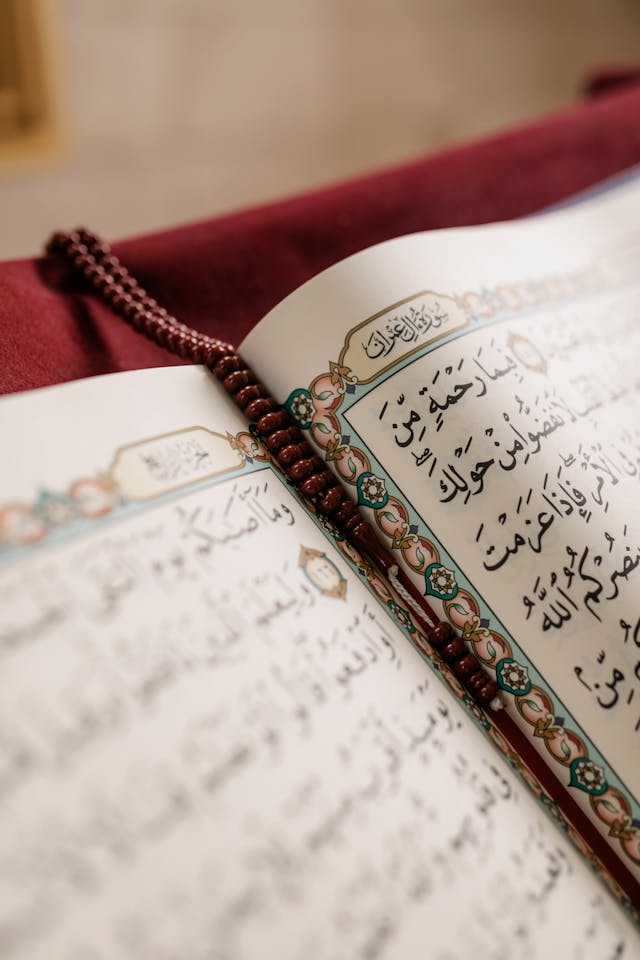
If you’re a beginner learning Arabic, you should have conversations with native speakers to improve your level; otherwise, you’ll remain a beginner for a long time.
You can actually speak fluently even before finishing your full curriculum, because in most cases, you’ll be speaking in the dialect of Arabic, which is easier and more commonly used in daily life.
So, if you want to communicate fluently with native speakers, focus on learning and practicing the common dialects. They’ll make it much easier for you to speak Arabic fluently, even if you’re still a beginner.
Fusha or local dialects, which should you learn first?
You must learn Modern Standard Arabic (Fusha) first if your goal is to learn to recite the Quran correctly and understand its meanings.
to be able to recognize the origin of words, pronunciation methods, and articulation points of letters and sounds like ‘ع’ (Ayn), ‘غ’ (Ghayn), ‘ق’ (Qaf), and ‘ك’ (Kaf).
This will make it easier for you to learn the Quran and understand its meanings.
Through Fusha, you will also be able to divide speech into nouns, verbs, and particles, and then break down sentences into nominal sentences (with a subject and predicate)
and verbal sentences (with a verb, subject, and object). This is called grammar (Nahw).
After that, you need to learn one Arabic dialect. For example, the Egyptian dialect is easy, fast, and simple. All Arabs can understand it.
It will help you a lot in daily life and when talking with Arabs because they don’t use formal Arabic (Fusha) in everyday talk.

Where is Fusha Arabic spoken?
Fusha is mostly spoken in official meetings, news broadcasts, and educational settings such as universities and television interviews. It is also used in official correspondence and government statements.
What is the most effective method for learning Arabic?
Join a School:
To speak Arabic fluently, being in an academic learning environment speeds up the learning process and gives you better results, away from randomness.
Choose a Gradual Curriculum:
Start with the basics of letters and their pronunciation points, then move on to sentences.
Choose a Native Teacher:
One of the most effective ways to learn is to study with native teachers who master Arabic to help you correct your mistakes.
Set a Clear Goal:
Avoid exaggeration. Choose one clear goal, focus on it until you master it, then move to the next.
Join an Arabic Community:
Take part in Arabic groups so you can make friends to practice the language with and improve your vocabulary and expressions.
Where can you learn Arabic?
Learn Arabic fluently in Egypt
You can learn Arabic in specialized institutes in Egypt, as it’s one of the most popular places people choose to study Arabic.
It offers different learning programs, and the Egyptian dialect is easy to learn.
People are friendly and welcoming to foreigners, and the prices are affordable for those looking for low-cost options.
And you can find one-on-one Arabic classes there easily to be more focused.
Learn Arabic in Morocco
If you want to speak Arabic fluently in a beautiful tourist country that offers special programs to learn Arabic with language experts. Although the Moroccan dialect is a bit difficult, Morocco is a diverse country that welcomes Arabic learners from all over the world.
Learn Arabic in Saudi Arabia
Saudi Arabia is a great place to learn Arabic. Being close to Makkah and Madinah allows you to visit them often and study Islamic knowledge.
The Kingdom also offers specialized Arabic courses at universities, along with additional services for students.
Conclusion:
To speak Arabic fluently is one of the main goals for Arabic learners, as it enables them to connect, integrate, and communicate effectively within Arab and Muslim communities.
Achieving fluency requires consistent practice with native speakers to gain real-life language experience and maximize learning.
Furthermore, mastering Arabic fluently allows learners to recite the Qur’an correctly and deeply understand the true meanings of its verses.